Is a 7kW Charging Pile Fast or Slow? A Complete Home EV Charging Guide
With the rise of New Energy Vehicles (NEVs), many car owners face a common dilemma when choosing a home charging station: Is the frequently mentioned 7kW charging pile a fast charger or a slow charger? Will its speed meet the demands of daily commuting?
Today, we will break down the reality of 7kW AC charging piles, and help you understand what to expect from your home charging setup.
Quick Answer: A 7kW charging pile is categorized as an AC Slow Charger (Level 2) in the EV industry. It is not a DC fast charger.
1. The Bottom Line: 7kW is Standard AC Slow Charging
In the industry classification, both international standards (IEC 61851) and Chinese national standards (GB/T) clearly classify a 7kW charger as Slow Charging (AC).
Why is this distinction important? Because a 7kW charger outputs 220V single-phase AC power. This alternating current cannot be directly stored in the EV battery. It must first pass through the vehicle’s built-in On-Board Charger (OBC), which converts the AC into the DC power required by the battery.
Due to the physical constraints of a 220V residential circuit and the power limitations of your vehicle’s OBC, the charging speed is inherently limited compared to highway DC fast chargers (60kW – 120kW).
Metaphor for understanding: Think of a DC fast charger as a hospital IV drip—infusing energy quickly in an emergency. A 7kW AC slow charger, on the other hand, is like a slow cooker—perfect for gently and steadily replenishing energy over a long period, such as overnight.
2. Charging Speed Comparison: Where Does 7kW Stand?
To better visualize the performance of a 7kW charger, let’s compare it against other common AC charging power levels:
| Charging Power (AC) | Time to Fully Charge a Standard EV (~60 kWh battery) * | Ideal Use Case | Pros & Cons |
|---|---|---|---|
| 3.5kW – 3.7kW | 12 – 16 hours | Emergency charging, portable travel chargers | Pro: Extremely cheap, plugs into a standard outlet. Con: Too slow for daily commuting. |
| 7kW (The Main Focus) | 6 – 9 hours | Home private piles, corporate offices | Pro: The perfect balance of cost and speed. Ideal for “plug in at night, full battery in the morning.” Con: Charging time increases significantly for large battery packs. |
| 11kW – 22kW | 3 – 5 hours | Luxury apartments, commercial parking lots | Pro: Significantly faster. Con: Requires a 3-phase power supply. Higher installation and line modification costs. |
*Note: These are theoretical estimates. The actual charging speed is strictly limited by your EV’s internal On-Board Charger (OBC). For example, even with a 7kW pile, if your car’s OBC only supports a 3.5kW input, your actual charging speed will be capped at 3.5kW.
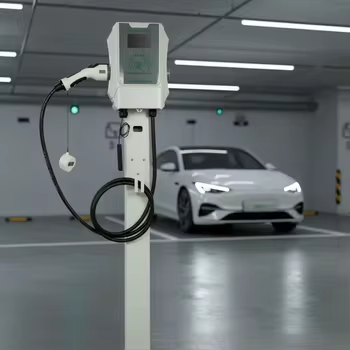
If you are looking for a reliable and cost-effective 7kW AC charging station for your daily commute, check out our recommended home AC charging station, which offers excellent performance for standard residential setups.
3. Is 7kW Fast or Slow? It Depends on Your Battery Size!
Many articles try to put a fixed label on 7kW chargers. However, the “speed” of a 7kW charger is actually relative, and highly dependent on your vehicle’s battery capacity. Typically, a 7kW charger delivers an actual output of about 6.5kW to 6.8kW (after accounting for cable losses).
For a 40 kWh Battery Pack (e.g., small sedans, micro EVs):
Charging from 0% to 100% takes approximately 5 to 6 hours. In this scenario, a 7kW charger acts like a “fairly fast” overnight charger.
For a 75 kWh Battery Pack (e.g., mid-to-large SUVs):
Charging from 0% to 100% takes approximately 11 to 12 hours. If you return home late in the evening and leave early the next morning, a 7kW charger might only charge the battery halfway. In this case, 7kW starts to feel “slow.”
4. Crucial Installation Facts You Must Know
If you are planning to install a 7kW charger, here are essential technical considerations:
- Electrical Circuit Safety: A 7kW device is a high-power electrical unit (roughly equivalent to running three 3HP air conditioners simultaneously). It cannot be plugged into a standard household wall socket. It requires a dedicated, professionally laid cable (e.g., 3-core copper wire, 6mm² or 10mm² for single-phase), a dedicated circuit breaker (with leakage protection), and an independent electricity meter. Ensuring proper grounding is critical to prevent electrical shock hazards.
- Why is 7kW better for home use? Compared to high-cost DC fast chargers, AC chargers have a much simpler structure. They don’t require complex rectifier equipment—just connect the grid to the input and the car to the output. This translates to lower costs, a smaller physical footprint, and lower failure rates.
- Healthier for your battery: AC slow charging causes significantly less damage to lithium-ion EV batteries than high-frequency DC fast charging. For daily commuting, using a 7kW AC charger to gently “trickle” charge overnight not only saves money but also actively prolongs your battery’s lifespan.
5. Summary and Verdict: Is 7kW Right for You?
A 7kW charging pile is the “gold standard” for basic home EV charging.
A 7kW charger is the best choice for you if:
- You have a dedicated parking space (garage or fixed underground spot).
- Your daily commute is between 50 to 100 kilometers (or approx. 30-60 miles).
- You have the habit of plugging in your car when you return home in the evening and unplugging it the next morning.
Final takeaway: A 7kW charger doesn’t charge your car rapidly, but it charges it just right. For the vast majority of private car owners, spending premium money chasing ultra-high charging power that you rarely use is unnecessary. Instead, investing in a reliable, safe, and cost-effective 7kW AC charging pile is the smart, high-value choice for your daily EV lifestyle.
If you are looking for the perfect AC charging station for your garage, don’t miss out on our stylish Flowing Light Series AC charging station, featuring a modern aesthetic that complements any home environment.